TROPECOLNET
 Project picture. Image credit © 2023 https://www.anabenitezlopez.com/.
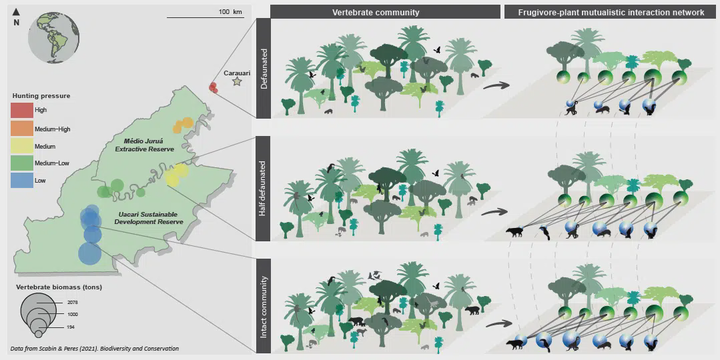
Characterizing the role of interacting species, the drivers and the structure of plant-frugivore ecological networks along a defaunation gradient in tropical forests (2023-2026, PID2022-138272NA-I00)
Description
In the TROPECOLNET project we will strengthen our characterization of ecological networks along a defaunation gradient in hyperdiverse tropical ecosystems with complementary but distinct goals. We aim to understand (1) how the topological structure for mutualistic, antagonistic and hybrid networks changes along disturbance gradients; (2) how species roles shift along the defaunation gradient, with species becoming less central, or losing their role as network cores, and others replacing these roles due to nonrandom (functional) extinction of large-bodied vertebrates; (3) how different network layers can be connected spatially in a multilayer framework with interlayer links based on differences in species population biomass, and with layers depicting sites with different defaunation signature; (4) how the general network structure in a defaunation landscape is shaped by exogeneous drivers; and, lastly, (5) how functional diversity of vertebrates is linked to network structure. In particular, this project will fill key knowledge gaps by focusing on hybrid networks, employing adequate replication to assess network structure with different approaches (single layers, multilayer, multispecies individual-based networks), and integrating functional diversity metrics and topological structure metrics.
Find out more on the Dr. Ana Benítez López website.

Caroline C. Vasconcelos
Research Fellow
My research interests include taxonomy and systematics (especially neotropical Sapotaceae), spectroscopy as a integrative tools, Amazonian flora, species distribution modeling, floristic studies, and tropical forest ecology.